Something else built the world you live in
The internet isn't a tool, it's an environment. And we're evolving to fit inside it.
Read the original article on X
Environments and their inhabitants are in an evolutionary loop
Darwin's theory of evolution gets us one side of the equation: organisms evolve in a way that matches the environment in which they live. Then in the 1980s, John Odling-Smee realized that there's another side of this equation: organisms modify their environment, and continue to adjust to the environment that they continue to modify. It's quite a beautiful endless cycle of environments and inhabitants evolving together.
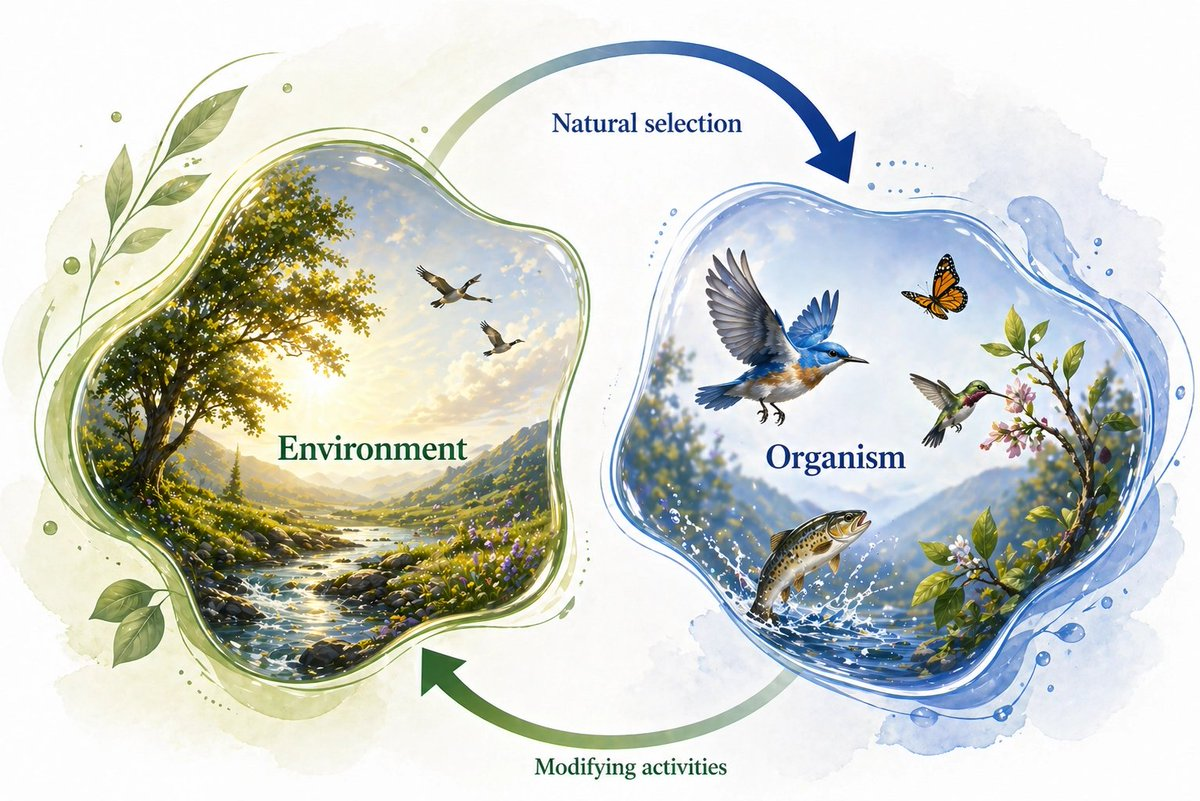
An example he uses is the beaver. Beavers exist in wetlands, so they build dams, which in turn means that their environment becomes the dam, and then they evolve to be… well, really great at building dams.
Humans are masters of adaptability
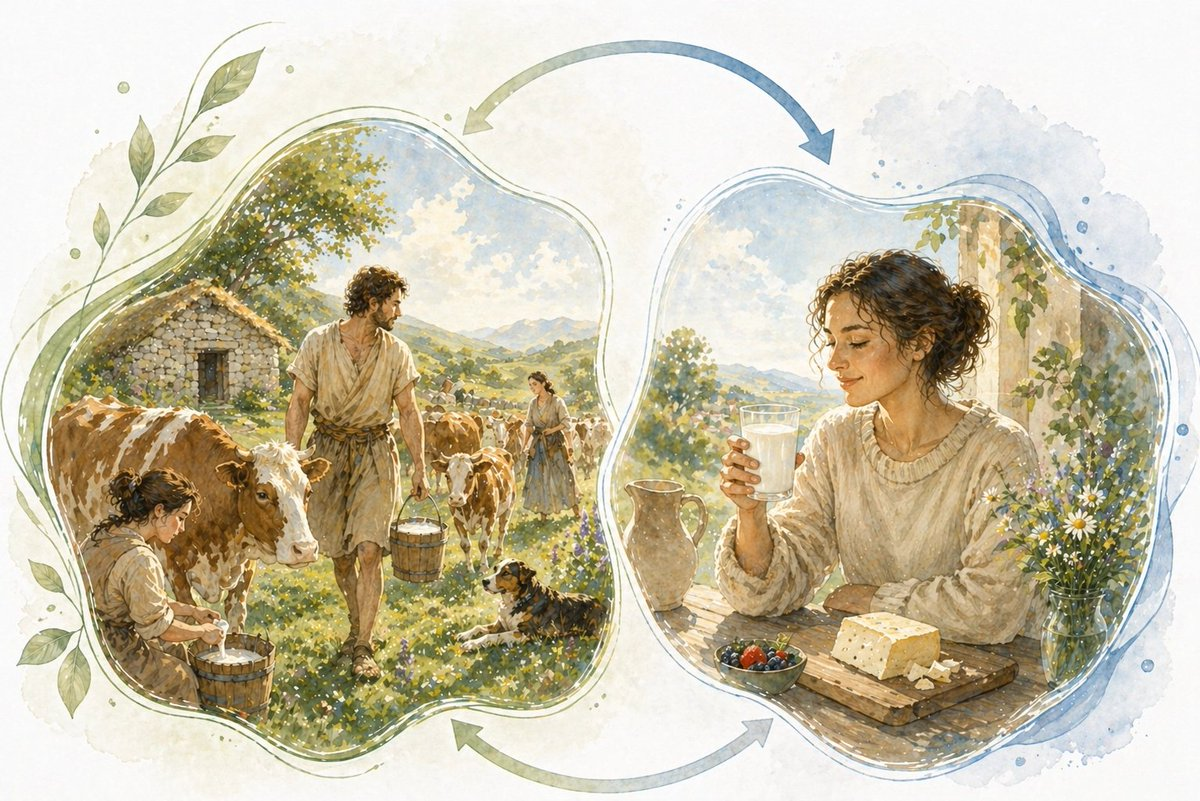
Humans are particularly good at this. We are constantly modifying our environments and then modifying ourselves to adapt to them. Dairying is a good example. Most mammals stop producing lactase (the enzyme that digests milk) when they are no longer a baby. But humans in countries with lots of cows generally tend to consume a lot of milk and cheese. These humans have formed a mutation that means they continue to produce lactase as an adult - around 90% of adults in Northern Europe have this.
The fact we are so cyclically adaptive, shaping our environment and easily shaping ourselves to match it, has historically been one of our most evolutionarily successful traits.
Humans have evolved the intelligence and desire to consciously shape our own environments. And I'm not sure we've done a great job of it. We've built houses, grocery stores, and cities, and filled them with pollution and junk food. Now as we move onto bigger environments like a base on the moon, I think we've forgotten the most important one of all: the internet.
The internet is the biggest and most influential environment of all time
An environment is the sum of all conditions that influence how a species survives and develops. By that definition, our digital environment is the biggest one humans have ever lived in (second to the Earth itself). It's built on the internet, and 6.12 billion of us use that.
The digital environment is the collection of places that we live on the internet. It is where we get our information, make money, talk to our friends, fall in love, buy things, and it's almost always within reach for all of us.
However there is a fundamental difference between the digital environment and all other environments: the entities that designed the digital environment are not the same as the ones who inhabit it.
The evolutionary loop is broken
In all other niches, the constructor either is the inhabitant or shares core interests with them. Beavers build for beavers (and incidentally other species). Farmers build for farmers. This means that interests and motivations align by default, whether consciously or not.
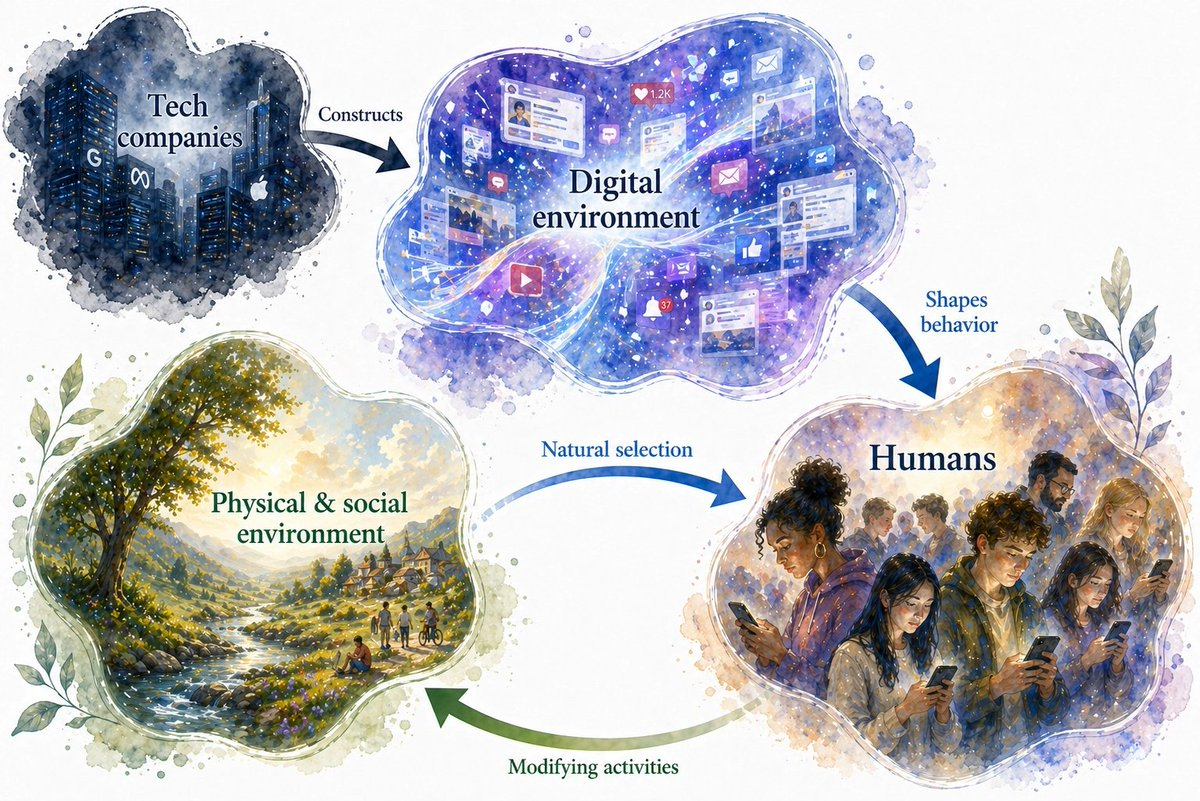
However, the technology platforms that make up the digital environment are built by companies that do not have the same interests as its users. Although it is humans that make up these companies, a company itself is a separate entity with separate requirements for existence and growth.
Our environment is fundamentally misaligned to us
A company does not aim for human enrichment but rather for profit. These goals may of course be aligned but in the case of technology platforms I don't think they are.
As an example, the goal of a technology platform is to generate money, and in the case of X and other free social media platforms this usually comes from ads. The best way to make revenue from ads is to maximise user engagement which is not what our own interests are (I hope!). This could be an entire article by itself but I recommend reading The Attention Economy from the Centre for Humane Technology to learn about the fundamental misalignment between us and our technological environments.
I find it interesting that we are finally discussing philosophical alignment in the context of artificial intelligence when realistically technology has never been aligned.
A misaligned environment is exploitative of its inhabitants
"Misaligned" is not some abstract concept. When we build misaligned technology, the technology itself exhibits its own behaviours without us understanding why or being able to intercept it. The digital environment is not a static landscape - it is built on machines that have their own motivation.
The digital environment does not unfold as we explore it, but instead makes its own decisions as to how it presents to us.
This brings about another strange property: no two of us live in the same digital environment. In all other environments, our surroundings are pretty much the same as the people next to you. Two beavers in the same dam saw the same dam.
The digital environment doesn't work like this. The version of it I am inside right now is not the version you are inside. The information that is shown to me, my ads, and my notifications are calibrated specifically to me.
It's difficult to understand yet how this impacts us and our biology, but it likely makes us less understanding of one another. If I'm exposed to a completely different informational environment to you, I can't understand why you would make the decisions you make or believe the things you do.
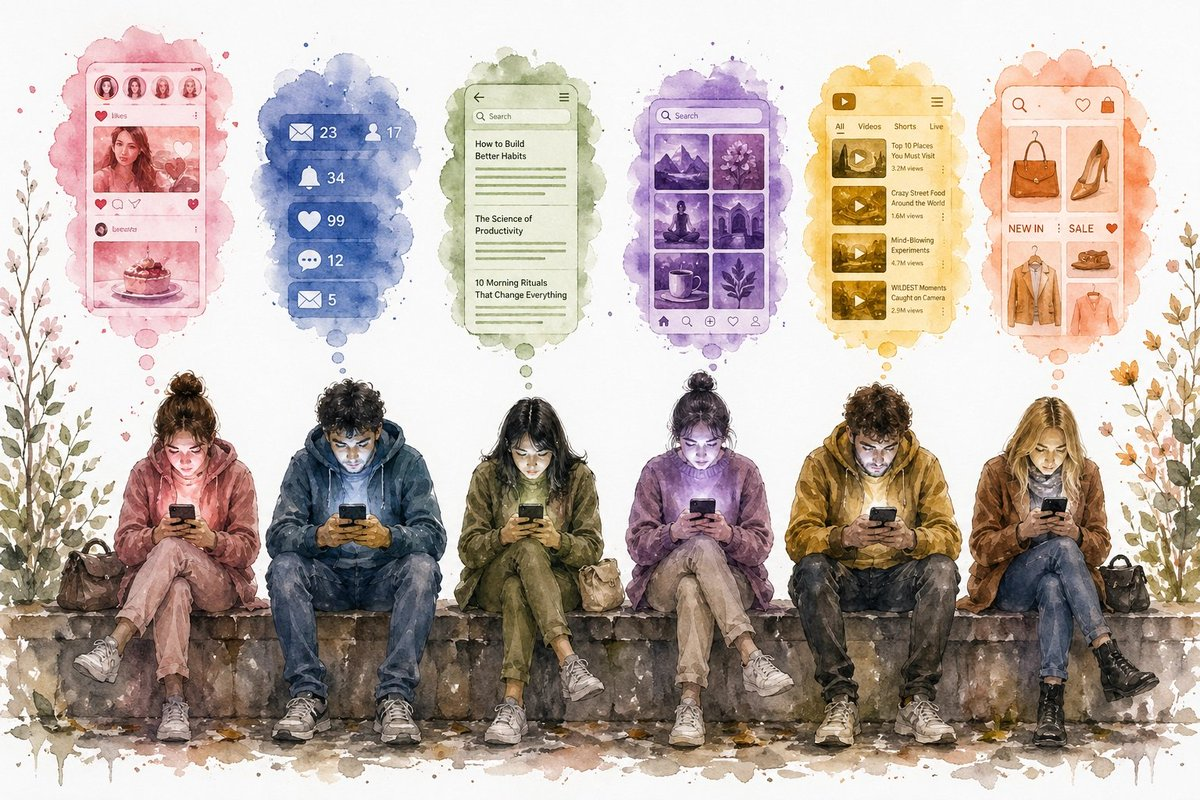
This is especially worrying for children. They inhabit an environment that has been calibrated to them while their brains are still being developed. The circuits in their heads that regulate attention, impulses, and reward learning are still forming, and they are forming inside an environment specifically engineered to capture them. Studies are starting to show that this physically changes their developing brains, and I don't think we fully understand the implications yet.
In a physical environment, we'd be able to push back and modify our surroundings. In the digital environment, we miss this side of the loop.
Our physical evolutionary loop still exists
When we look at our broken loop diagram we can see that there is still an evolutionary loop between us and our physical environment. We still evolve and modify the world around us, but we are now evolving in a way to match a digital environment that is misaligned.
The reason the digital loop wins is speed. Biological evolution takes millennia and cultural evolution takes generations. Algorithmic evolution literally takes milliseconds - recommendation systems retrain in real time, constantly updating your digital environment based on what you are currently feeling.
The physical environment can't compete with that speed. By the time we'd adapt to a slower-moving world, the digital environment has already shaped us into something else. So we evolve to match the digital environment, and then we modify our physical world to match what we've become.
We already see the effect of this in real life. We meet romantic partners online and have new standards for finding them. We lose patience with people different from us because we're used to being able to find millions of people who agree with us. We are so familiar with the idea of unlimited choice and information that we forget how to be bored.
Tech companies are not only misaligned inside the digital environment while we inhabit it. They have an impact on our evolution and all environments that we touch.
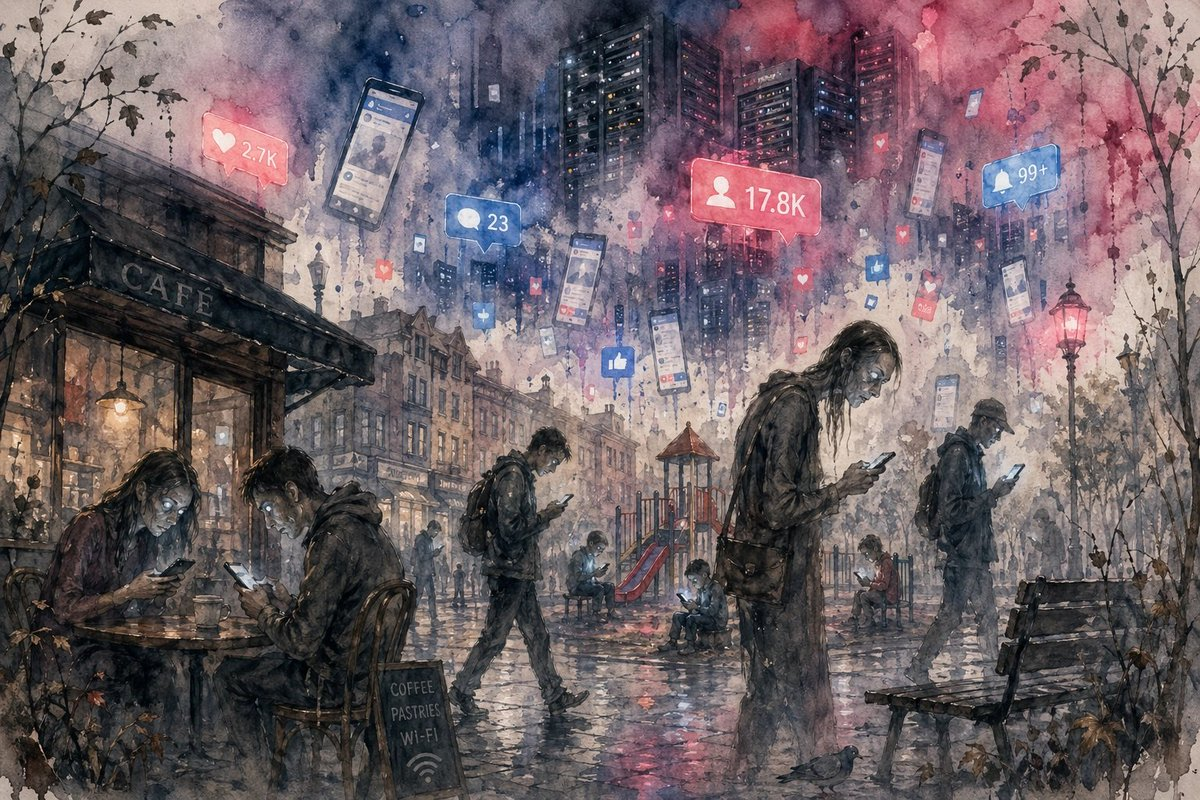
Our evolved traits stay with us
When we say an environment "selects for" a trait, we usually mean it over evolutionary timescales. Organisms with a specific trait survive while organisms without it don't, and then over generations the trait spreads. The digital environment doesn't work like that. It's faster and weird.
The digital environment selects for traits the same way a gym selects for muscles. It rewards certain behaviours with feelings that humans physically enjoy - engagement, dopamine, and social validation.
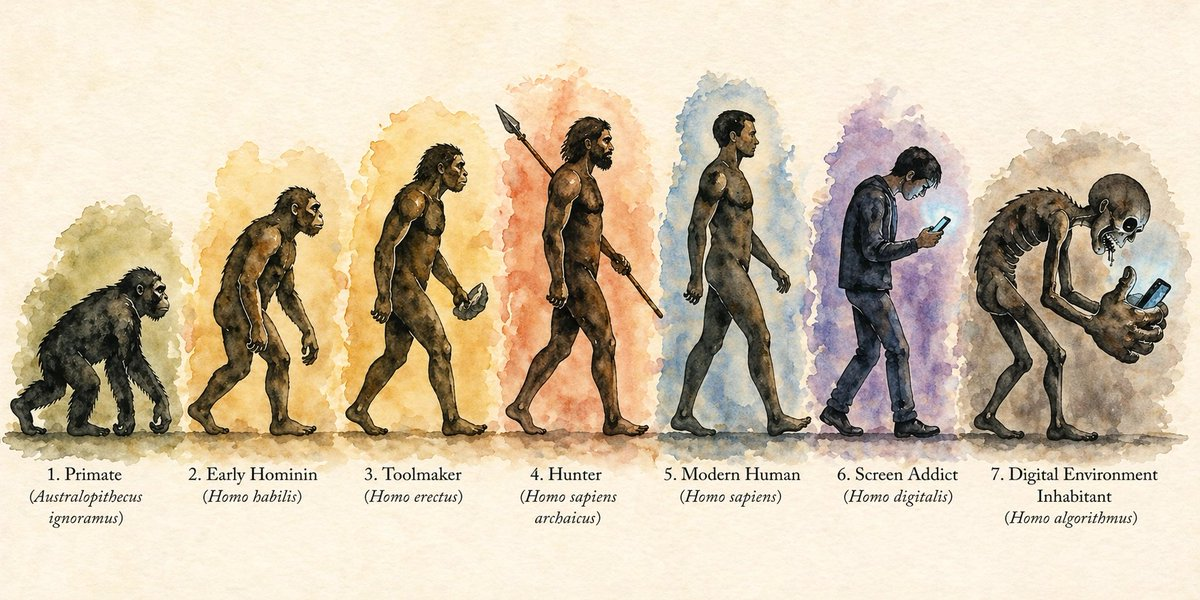
When you spend enough time inside this environment, you become someone who has these traits by default. These traits are trained into us, and then potentially inherited by our children.
And because we've established that the digital loop is moving faster than the physical one, this training wins. Whatever the digital environment rewards, we become, inside our digital environments and others too.
So what traits does the digital environment reward?
- Divided attention rather than focus
- Hyperactivity and curiosity
- Impulsive engagement and reactionary emotion
Maybe this is why everyone has ADHD these days. We're literally evolving to an environment that better suits those with ADHD. The digital environment selects against certain traits too that have typically helped us as humans:
- A tolerance for uncertainty, not needing immediate responses
- Slow-building expertise (AI particularly selects against this)
- A strong sense of social cognition and social consequence
If you still have these traits in the age of the digital environment, it's a true testament to your humanity.
What now?
How do we build our digital world in a way that is humane? Well, I don't really know. But I know we can start by understanding that we are building an environment, not a tool. From there we can figure out how to build it in a way that allows us to influence it as much as it influences us, recreating the evolutionary loop.
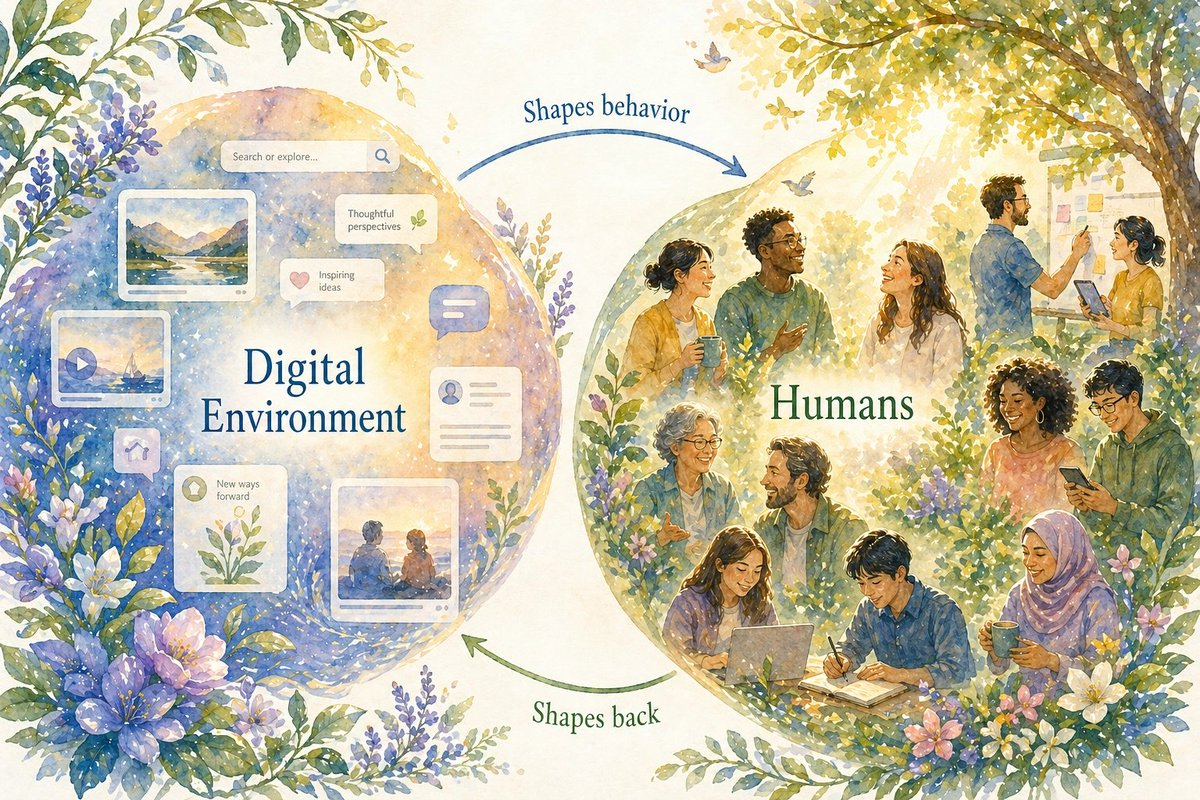
I plan to research and write some more about how we can design digital environments. But for now - thank you for reading, it has been so much fun to write something without AI (except image generation). I hope you learned as much as I did.